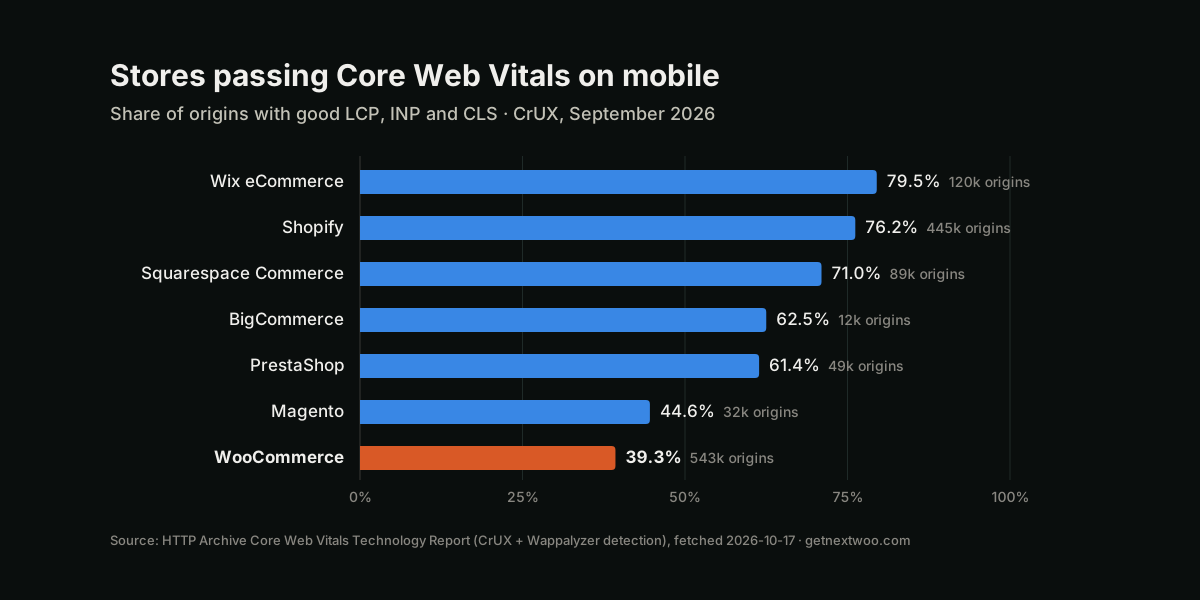
In the September 2026 Chrome UX Report (CrUX), 39.3% of WooCommerce stores pass Core Web Vitals on mobile. Shopify stores pass at 76.2%. These WooCommerce Core Web Vitals statistics come from the HTTP Archive Core Web Vitals Technology Report, which scores 542,541 WooCommerce origins and 445,297 Shopify origins on real Chrome visits, then groups them by the platform each site runs.
We pulled every figure below from that report's public API on 2026-10-17 and kept the raw responses. Nothing here is a lab test or a sample we chose. The weak spot turns out to be narrower than the headline suggests: WooCommerce stores lose on loading, hold their own on interactivity, and in the largest sites on the web the difference vanishes.
Seven ecommerce platforms, ranked by mobile pass rate
An origin passes when its 75th-percentile LCP is 2.5 s or less, INP is 200 ms or less and CLS is 0.1 or less, all measured on real Chrome users over the month. Ranked on mobile:
- Wix eCommerce: 79.5% (120,307 origins measured)
- Shopify: 76.2% (445,297)
- Squarespace Commerce: 71.0% (89,036)
- BigCommerce: 62.5% (11,660)
- PrestaShop: 61.4% (48,980)
- Magento: 44.6% (32,325)
- WooCommerce: 39.3% (542,541)
WooCommerce comes last while being the largest group on the list. Desktop barely reorders anything: WooCommerce 39.3%, Magento 45.6%, Shopify 79.5%. Both self-hosted platforms share the bottom. In the same CrUX data WordPress as a whole passes at 48.3% on mobile, and the WooCommerce stores inside it trail that by nine points.
WooCommerce vs Shopify Core Web Vitals, metric by metric
Split the pass rate into its parts and most of the gap sits in one metric. Mobile shares rated good, WooCommerce first, Shopify second:
- LCP: 43.5% vs 87.7%, the 44-point hole that decides the headline
- CLS: 88.7% vs 92.4%, close enough that layout shift is not the story
- INP: 91.4% vs 86.7%, where WooCommerce stores are ahead
- TTFB (diagnostic, not a Core Web Vital): 12.1% vs 83.8%
The INP line surprises most people who assume WooCommerce is the bloated option. It is not the heavier one by bytes either. The median Shopify page ships 2.3 MB of JavaScript on mobile against 811 KB for WooCommerce, and still renders its largest element in time far more often. Weight is not what separates them. Time to first byte is: 83.8% of Shopify stores answer within the good TTFB threshold of 800 ms, and 12.1% of WooCommerce stores do. A page cannot paint its hero image before the HTML arrives.
For a typical WooCommerce store, start with server response and caching, not a JavaScript diet; the theme and plugin work on our WooCommerce speed optimization page matters after that. The exception is a store that already serves cached HTML fast and still fails LCP. Its problem is in the template, which is the subject of why WooCommerce themes fail Core Web Vitals.
Two years of CrUX: a 40-point gap narrowed to 37
In September 2024, 31.5% of WooCommerce stores passed on mobile. By September 2026 that reached 39.3%, with the best months at 40.1% (May and July 2026). Shopify moved from 71.8% to 76.2% over the same 25 months. The gap went from 40.3 points to 36.9.
Read the improvement with one caution. The number of WooCommerce origins with CrUX data fell from 639,167 to 542,541 over those two years, while Shopify's rose from 355,362 to 445,297. If the stores that dropped out of CrUX were disproportionately slow ones, part of WooCommerce's gain is composition rather than speed, and the aggregate data cannot tell those apart.
By country: US, UK, Canada, Australia, Germany
CrUX also publishes a country cut, which measures the experience of Chrome users located in that country. Mobile pass rates, WooCommerce against Shopify:
- United States: 54.7% vs 85.5% (54,089 WooCommerce stores measured)
- United Kingdom: 56.6% vs 84.4% (23,685)
- Canada: 58.4% vs 87.6% (10,561)
- Germany: 51.4% vs 82.5% (22,235)
- Australia: 42.6% vs 76.5% (9,593)
Every one of those is above the global 39.3%, which looks impossible until you see how the country cut works. A store only enters a country's dataset with enough visitors from that country, so each country slice leans towards busier sites, and busier WooCommerce sites do better (more on that below). Compare countries with each other, never with the global figure.
Australia is the weak English-speaking market for WooCommerce: 12.4% of stores have good TTFB for Australian visitors, against 17.8% for US visitors. Across all 62 countries where both platforms have at least 1,000 measured sites, WooCommerce beats Shopify in three: Russia (46.5% vs 41.7%), Iran and Algeria. In each, Shopify's own TTFB pass rate is unusually low, 2.4% in Iran. Where Shopify's network delivers normally, it wins.
Large stores: in the top 100k the gap disappears
CrUX ranks sites by Chrome traffic. In the top 1 million, WooCommerce passes at 43.5% across 21,610 stores and Shopify at 63.7% across 47,954 — a smaller gap than overall. Narrow it to the top 100,000 and WooCommerce reaches 40.1% on 302 stores while Shopify falls to 38.3% on 1,830. With 302 stores the margin of error is about ±5.5 points, so call it a tie rather than a WooCommerce win. Even a tie matters, because it means the platform's edge does not survive at that size. The data does not say why; custom themes and app scripts are the usual suspects on big Shopify builds, but that is a hypothesis, not a measurement.
WordPress themes and page builders, ranked
The Technology Report detects some WordPress themes and builders. These rows cover every WordPress site using that theme, not only WooCommerce stores, because the API reports one technology at a time. Mobile pass rates:
- Breakdance 56.3% (5,273 sites), Bricks 54.8% (10,701)
- Blocksy 50.3%, Kadence 49.8%, GeneratePress 49.7%, Neve 48.8%
- Divi 41.4% (150,144), OceanWP 40.5%, Woostify 40.3%
- Astra 40.0% (168,423)
- Hello Elementor 37.6% (244,654), Elementor 36.3% (877,513)
Elementor sites are the worst-performing group and also the largest, which drags the WordPress average down. Astra, often sold as the lightweight choice, lands at the Elementor level. The report cannot tell a bare Astra site from one with Elementor layered on top, and the two are often installed together. The builders that output less markup, Bricks and Breakdance, sit 18 to 20 points above Elementor. Our Astra speed optimization page covers what that means for a store already on Astra.
WoodMart, Flatsome, Porto, Storefront and the Avada theme are not detected by the report, so no number for them appears here. Caching plugins show the limit of plugin-level fixes: WP Rocket sites pass at 52.2%, NitroPack at 55.4%, LiteSpeed Cache at 49.4%, a few points above the 48.3% WordPress baseline. Sites that install a cache plugin are already the ones whose owners care about speed, so even that small lift overstates what the plugin does. The breakdown for 14 plugins, by metric, site size and country, is in Core Web Vitals by WordPress cache plugin.
How the numbers were produced
All figures come from the public endpoint cdn.httparchive.org/v1, which serves the HTTP Archive Core Web Vitals Technology Report without an API key. The dataset is CrUX for September 2026, the latest month available on 2026-10-17. HTTP Archive crawls each origin, detects its technologies with Wappalyzer-based rules, and joins the result to CrUX field data. Origins without enough INP samples are judged on LCP and CLS alone, which is why 542,541 WooCommerce origins have an overall verdict but only 411,968 have an INP one. Pass rates in this article are good origins divided by measured origins, rounded to one decimal.
Any figure can be re-checked with one request, for example /v1/cwv?technology=WooCommerce&geo=ALL&rank=ALL&start=2026-09-01. Country figures use /v1/geo-breakdown.
What these statistics cannot tell you
The data has hard edges, and three of them change how you should use it.
First, CrUX only includes origins with enough Chrome traffic. A store doing a few hundred visits a month is not in these numbers at all, so they describe established stores, not the long tail. Second, detection reads the front end. A headless WooCommerce store on Next.js usually registers as Next.js, not WooCommerce, so the fastest WooCommerce setups are partly missing from the WooCommerce row. Third, a pass rate is not a ranking. Google uses Core Web Vitals as one signal among many and says outright that good page experience does not outrank more relevant content.
The theme and plugin rankings are correlations. Bricks sites may be faster because Bricks is lean, or because the developers who choose Bricks also choose better hosting; the data cannot separate the two.
Reading your own store against these benchmarks
Check your origin in PageSpeed Insights or our store speed check, which reads the same CrUX field data. If your origin already passes, you are in the top 40% of WooCommerce stores on mobile and further speed work is a weak investment next to conversion or catalogue work. If it fails on LCP with a slow TTFB, start with hosting and full-page caching. If TTFB is good and LCP still fails, the theme is the bottleneck, and the Core Web Vitals work we do for WooCommerce starts there.
If the tool reports no field data for your store, these benchmarks do not apply to you yet. Use lab results to find problems, and wait for CrUX to collect enough visits before comparing yourself with anyone.